

Get Jinky With It
Scooby-Doo and the Integration of Modern Mythos

The Mystery Gang & Their Archetypes
The Planned Trick (The Uncanny): The problems in the world aren’t out of the realm of Scooby-Doo. The problems are easily explained by selfishness and the desire for money. (Capitalism.) Seemingly supernatural threats are just masked villains and unique contraptions.
Hunting the Paranormal (The Marvelous): There are real supernatural threats. The problems may only be defeated by magical, mystical means. The supernatural eventually becomes accepted as a part of the reality of Scooby-Doo.
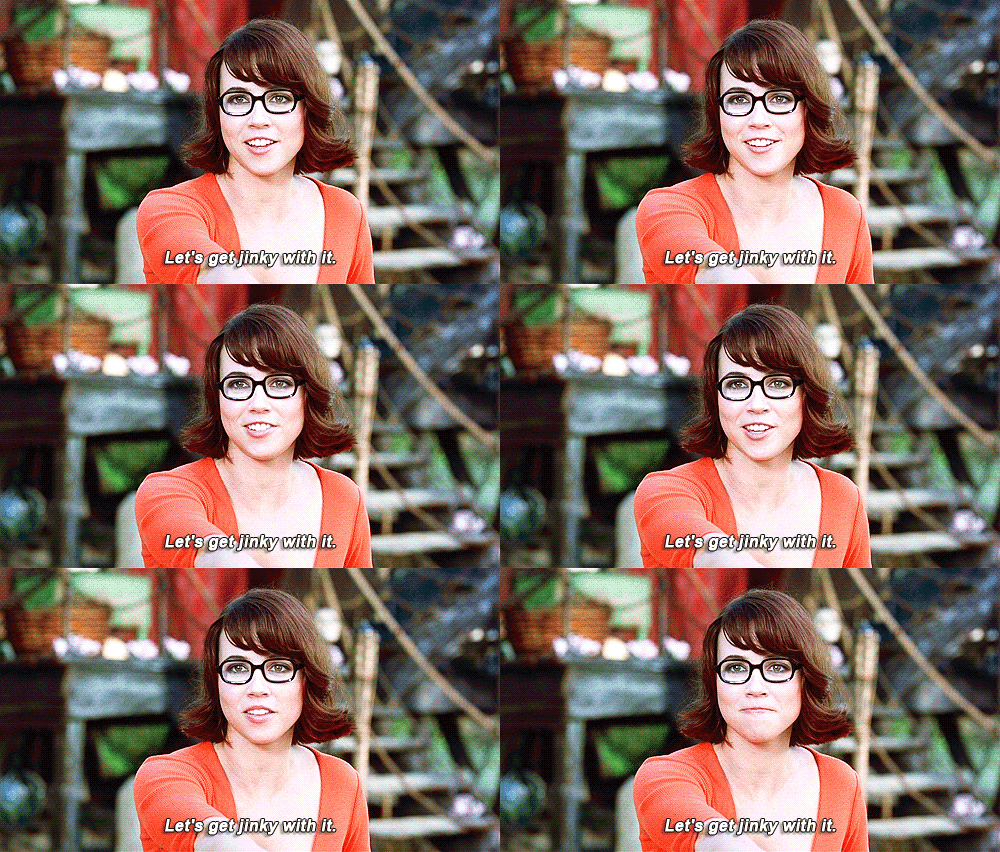
Unsolved (The Fantastic): There’s precedent for both rational and irrational explanations. Monsters can be real, as well as the masked, disgruntled, very human villains. In different episodes of Scooby-Doo, there are moments of uncertainty between each, exposing duality. A hesitation in our confidence won’t allow us to place ourselves in The Uncanny or The Marvelous, which would ultimately appease our minds. This is most evident in Mystery Incorporated as it rolled out each week on live TV as a guessing game for audiences. The more subtle example occurs when Velma (a trustworthy character) looses her glasses so that she can’t see clearly. If she’s not sure about her reality, how are we sure? Spooky! 👻
Characters -
Fred as The Strong Leader
Daphne as The Popular Damsel
Velma as The Smart One
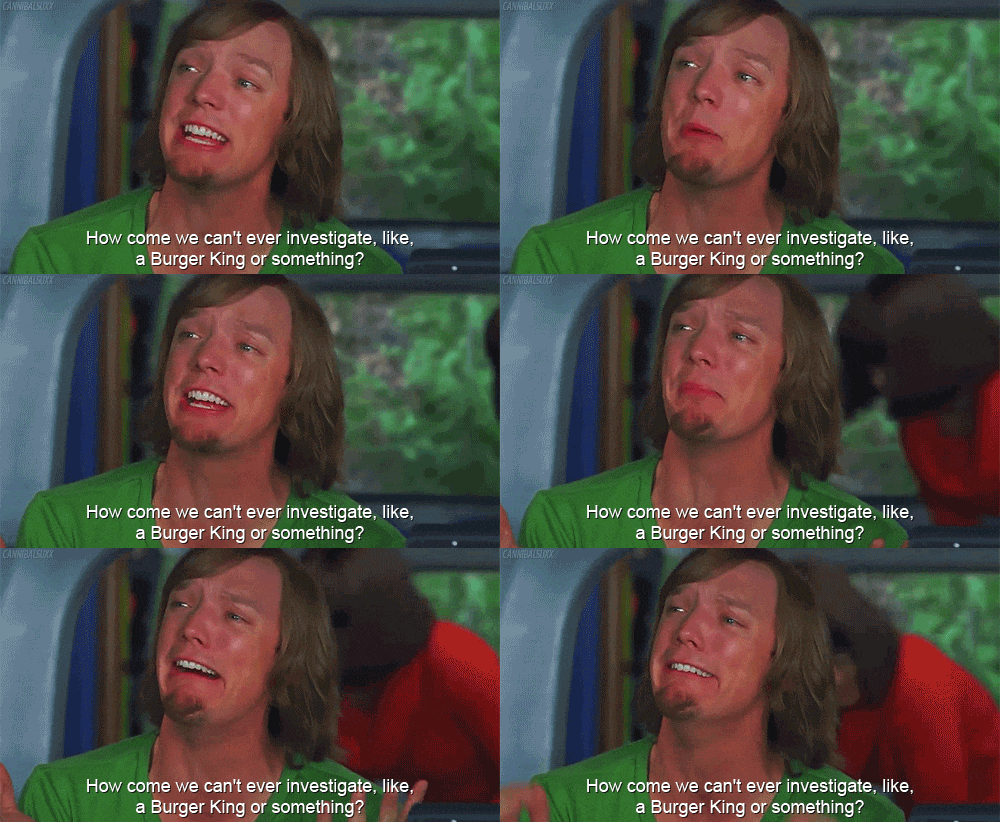
Shaggy as The Jokey Stoner
Scooby as The Loyal Companion
These archetypes are markers of their era. The composition of characters for this show was based on pre-existing media (The Many Loves of Dobie Gillis). The creation was formulaic. Scooby-Doo became successful precisely because they dabbled in the supernatural without being too horrifying. It had to be palatable for general audiences.
How the characters adhere to the archetypes has been messed with throughout the Scooby-Doo franchise for multiple purposes. Usually, it’s humorous to the audience. It may be obvious or subtle and shifts how we see the overall narrative of the episode.
Villains -
The Supernatural Spook (Paranormal Monster)
The Greedy Boss (Masked Menace)
In the era of the late 60s--with civil rights activations, the Vietnam War, and a president assassinated--TV mirrored the public mistrust, the fight between good vs. evil (us vs. them), and portrayed heroics and violence particularly. Again, this storytelling adapts as Scooby-Doo continues through time.
Is Shaggy a stoner? Is Velma gay?
Yes. & Yes.
Velma has a queer love interest in the Trick or Treat Scooby-Doo (2022) movie. From now on, we'll get these depictions of Velma as the cool queer that we always knew she was. No more subtext. The queer community won’t have it.
Although Hanna Barbera has denied both characterizations before, saying that a stoner Shaggy and a gay Velma wouldn't have been welcome on the 1960s-70s Saturday morning slot as such and therefore couldn’t possibly also exist that way, we've all read the subtext. The clues 🔎 were there throughout the last 50 years.
At what point do we acknowledge our modern mythos as an integration of our reality?
I’ve been wondering this for a long time. I guess I’ll start exploring this question paranormally by inviting the Mystery Gang along for the ride! I’d like to think that all the time they spent in The Mystery Machine would have gone toward discussing and expanding their paranormal theories…
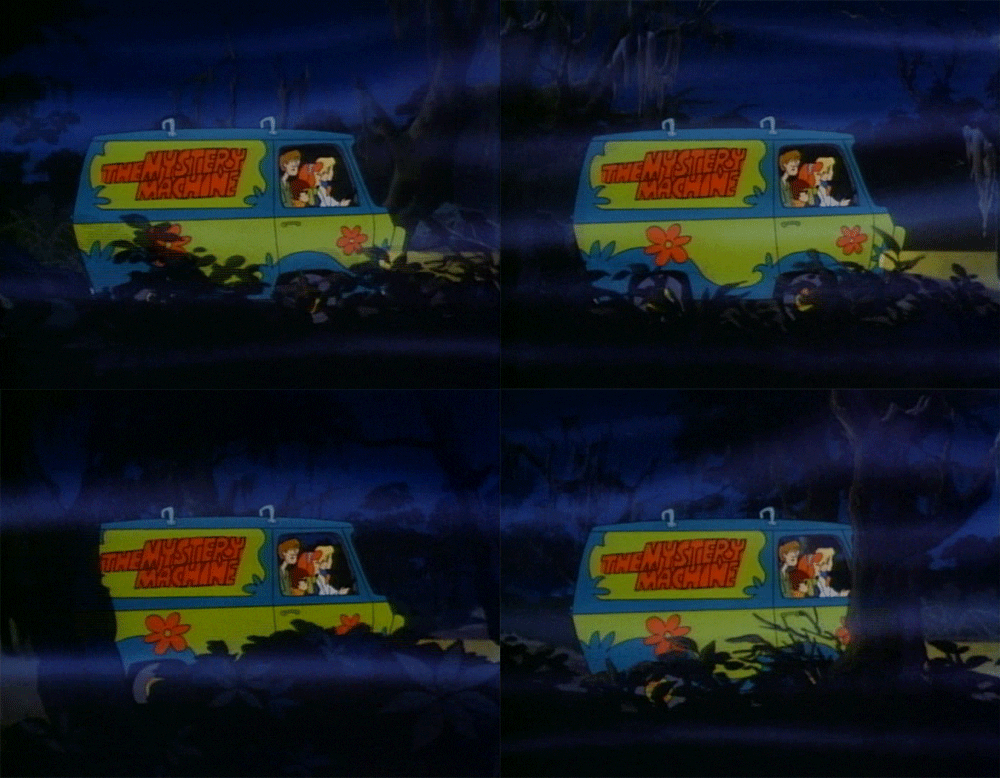
The answer is now. From now on. And always. I’m sure there was a point at which we crossed the threshold before we knew this was what we were doing. In other words, the integration is naturally co-occurring.
One mechanism of control operating more consciously to keep us disintegrated in our mythos is the censorship of mainstream media. Anything that goes on TV or gets popularly distributed always goes through a million and one channels before final release. We have to accept that our stories are filtered for “general viewership” at the approval of elitist boss-figures. Storytellers are left out of the process of our stories being told.
The uniqueness of our era is breaking down systems and structures, like the top-down mainstream media operating with such control. Breakdowns are imminent in our timeline of late-boi capitalism and we know this when we watch the systems and structures double-down on their power to spite us. On the date I write this post, Google is being criticized for the $45 million partnership with the Israeli prime minister to pay for global digital advertising (propaganda) on behalf of the settler state (“there is no forced famine in Gaza/the genocide isn’t real”). That $45 million is a lot to spend after almost 2 years of live-streamed murder and starvation of an entire population! I put my faith in the people and our awareness of truth. Still bleak, though.
At some point during the last few years, activists compared our time-period to that of the Vietnam War. This was for a lot of reasons, but namely used as a comparison in the event of Aaron Bushnell’s self-immolation. It harkened to the 1963 self-immolation of Thích Quảng Đức, a Vietnamese Buddhist monk, who’s photographed death circulated world-wide creating an emotional reaction and shift in our collective consciousness, especially about our role in global conflict. The similarities between then and now aren’t so that we can stay comfortable as American citizens after having witnessed tragedy; it’s a call to do better and move toward liberatory futures for ourselves so that our role in the world doesn’t continue to perpetuate the damage.
Mainstream media has dictated our stories for a long time. Hope can be found in the resistance, which sprouts everywhere. We erected these harmful structures, and we can break them down to replace them with something that works sustainably and alongside the values that motivate us. If we want authentic stories, we’ve got to be distributing them differently. Watermelon Pictures is doing just that! Zine culture exists for the same reason when it comes to print media. Social media has been another way for content to disseminate to the online groups we cultivate, albeit governed by select algorithms of each channel which make virality profitable. These are examples of how things naturally co-occur. We may not see the entire solution in front of us; meanwhile, people do the work to create different options.
As a creative and unrelenting fan of the Scooby-Doo franchise, it’s totally possible for me to retell the same archetypal story with contemporary nuance. Doing so would allow the nuance to carry the story further than ever before, especially if I could distribute it as a film through grassroots means. It’s just an example, but it’s a totally possible situation to imagine, provided the resources come together to make the film. We can wax all day, as I often do, about what’s possible as we move forward and still might never see those particular results. What I’m really talking about is integration of what’s already been into our present moment.
I have this theory (there they go again with the theories…) about contemporary works and how they show up paranormally. I generally think that they do and can upon our calling on them, like how a “ghost” in paranormal investigation might show up.
My friend pushed back on this theory: “Why would Micky Mouse show up in a paranormal investigation? He’s not real.”
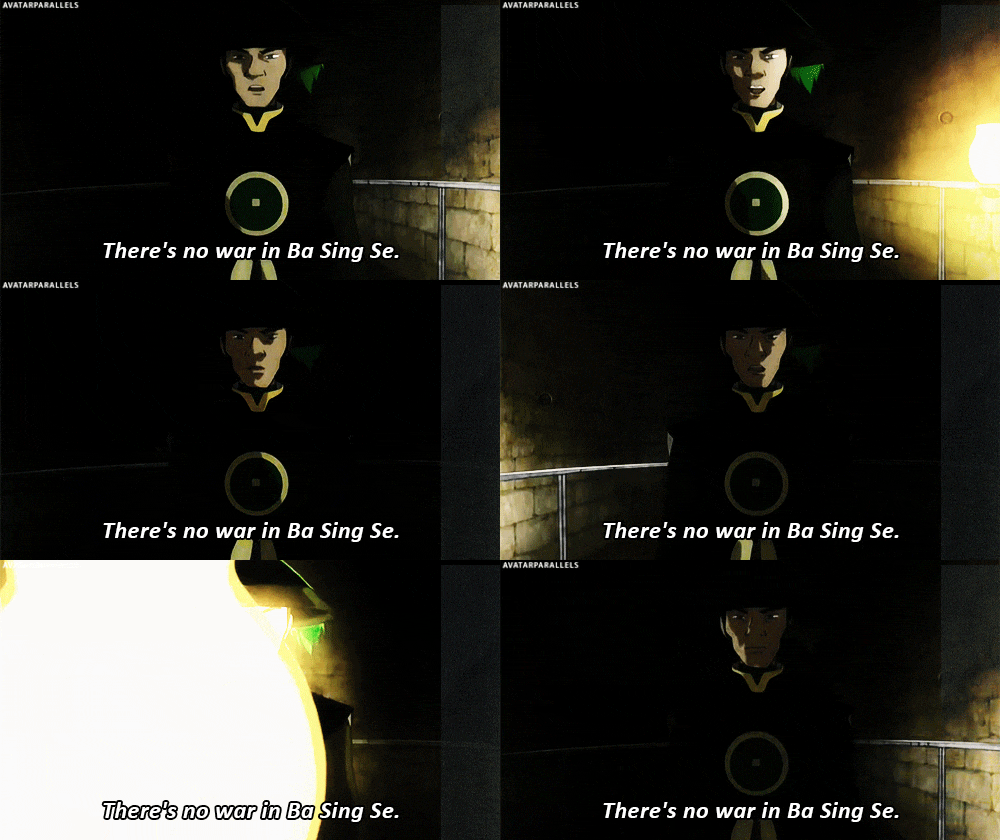
Ahh! What a concept. It’s not real. Just like there is no war in Ba Sing Se. 😵💫
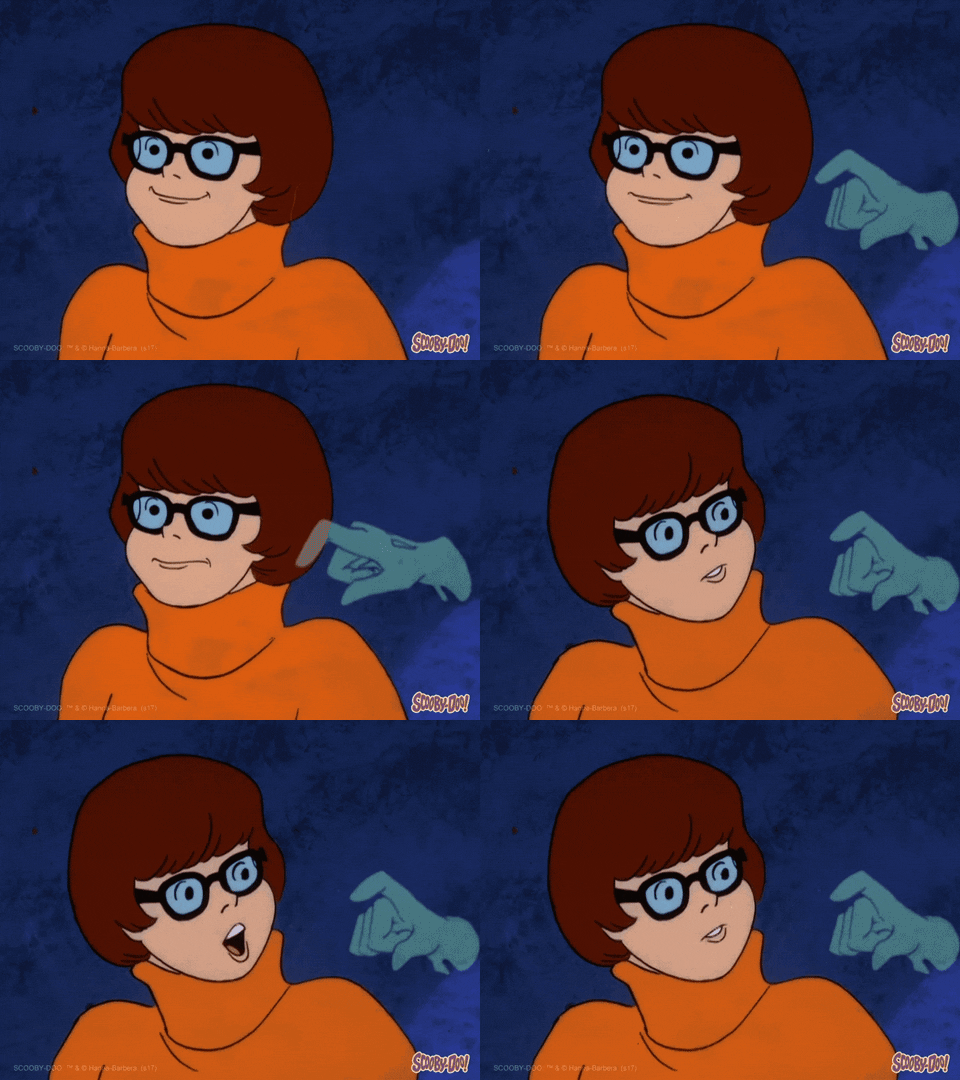
So what is real? What exactly is worth it for us to investigate? Are ghosts any more real than Mickey Mouse? Curious.
Curiouser is the heap of questions I have for paranormal investigators as of late: Why do you investigate? Why is it something you consider to be fun or worth your time and effort? What motivates you to show up? What motivates you to shut it down? The things that are dark and scary, or the things that challenge your perception of reality? I ask all this because innately, we push boundaries. How many of us are truly ready to have our boundaries pushed in return?
Jeffery Kripal, religious scholar and author, offers us a “Paranormal Criticism” in his 2019 book, The Flip. Below are quotes from the passage in which he offers his perspective on ours:
“The concept of the paranormal, then, is inherently ‘bimodal.’”
“As such, the paranormal is at once disenchanting and enchanting, both deeply suspicious of all supernatural explanations but also open to new super natural ones.”
“Such experiencers often (not always) recognize both the truth of the experiences themselves and the arbitrariness of the way these experiences are built up to public religious forms. This, in turn, I suspect, is what makes paranormal experiencers and experiences so culturally creative. It’s what also makes them so often resisted or feared.”
“Perhaps not accidentally, these experiencers are often professional intellectuals, gifted writers, and world-class scientists.”
“Paranormal Criticism” by Jeffery Kripal in The Flip: Epiphanies of Mind and the Future of Knowledge
Ok, let’s melt your mind here. Take a hit off the doob if you need to, pal.
When I was in psychosis, an eventful time I write about often, I perceived Louise Belcher in the mirror as if she were my own reflection. In the state of psychosis, a lot is going on in my head already. However, it was in these moments of utter uncertainty that I challenged myself to look closer.
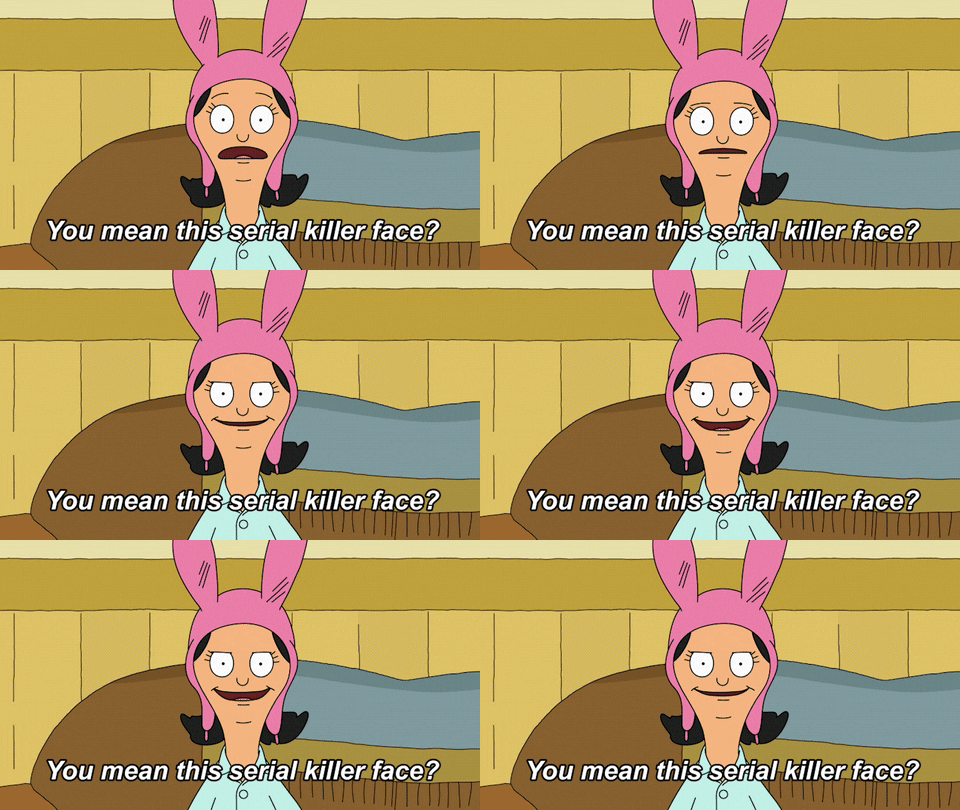
She was there. She was literally the reflection in the mirror. I didn’t see myself; in fact, I saw a world beyond Louise in that mirror. One could say that it’s my brain’s response to the psychosis, and I wouldn’t disagree. If I acknowledge the integration of contemporary works which carry these innovative supernatural or mystical elements, seeing Louise Belcher how I did isn’t as strange as it sounds. It’s reasonable and understandable.
To reduce the experience to a “delusion” or “hallucination” dishonors the ineffability, or indescribability, of the experience itself. That quality of ineffability, regardless of how we resolve it, exists plainly in mystical or supernatural experiences throughout our history. Inside psychosis, it is not anomalous to have delusions or hallucinations. It was in my several experiences with psychosis that I discovered a sense of dissociation that not only affected my own perception, but how I was perceived by outside forces. I felt, in the moment with Louise Belcher and other moments, that I was such an empty vessel for spiritual exploitation (as a result of my mental health) that I became like prey to energetic forces around me. The conclusion I came to, after having witnessed the entire scope of my experience with psychosis, that these energies existed outside myself and outside of my mental/emotional/spiritual/physical/social control. These energies had their own agency. (The last statement is very hard for paranormal investigators to admit to in the case that they believe it or have similar perceptions.)
Kripal suggests against naming the experiences as an overarching concept. I’ve done this kind of naming when I talk about how I saw a series of orbs in the sky in July of 2024. I call it a craft just because the entire experience fits the UFO mythos. Still, I don’t really know what it was because the ineffability of the event renders “orbs in the sky” as too ordinary of a description. There is no clear alternative, so naming it does feel useless. I’ve also rejected this naming when I reiterate that just because something vaguely spiritual happens in the event of psychosis doesn’t mean we should adopt the term “spiritual psychosis.” Quite often, people seem to be going through ontological shocks which make them a bit psychotic, but to call it “spiritual psychosis” dishonors the crisis and health concern.
“That is the double move I want to underline here as a ‘paranormal criticism.’ It is time to affirm the historical reality of these events without signing our names to any particular mythological or religious framing of them. The results, I hasten to add, are not uncritical with respect to religious belief. Quite the contrary, they can be devastatingly critical, far more critical than any purely secular approach would dream of being.”
I can see how my perspective is situated here in terms of my expertise as a paranormal researcher, investigator, writer, neurodivergent and queer-identified person who refused the conservative Christian indoctrination of my upbringing. My criticisms come from trying to survive in a world where my lived reality is constantly in question. I reject the gender binary, but I still live in the current paradigm which only marginalizes and persecutes my existence as a non-binary lesbian. I can live my truth through resistance, which is important to add because my existence is still here, being, in spite of the idea that I don’t or shouldn’t exist. Those who argue against my existence are the ones who are truly delusional.
Ultimately, I see Kripal’s point. And once we enter conversations about this kind of stuff, language becomes it’s own signifier of experience. My linguistic preferences, intellectual context, and artistic influences all veil the main point:
“One cannot ‘explain’ the imagination, any more than one can explain consciousness, since both are fundamental and cannot be reduced to anything else. This does not mean, of course, that one cannot trace and analyze how the kinesthetic body determines the content and images of the imagination … But, exactly as we have it in the philosophy of mind and physics, endless discussions of content and structure do not get us any closer to what the imagination is.”
(Kripal, 2019)
To my friend, I would say that it doesn’t matter if Micky Mouse, Scooby-Doo, or Louise Belcher comes through in an investigation or paranormal experience because we can ask a better question: What’s new? 👋
The reality is that paranormal investigators aren’t investigating because they’re aware of the inherent philosophical problem they’re attempting to solve. At least some of the time, it’s an aesthetic choice to investigate; otherwise, paranormal investigators have a myriad of reasons to pick up the practice. I think, especially after the popularization of the Estes Method, we’re assuming a lot about what’s happening when we interface with consciousness (both of ourselves and outside ourselves). To me, this is most evident in the online conversations paranormal investigators and spooky enthusiasts have with each other because what we say inside the community, which would include our specialized knowledge, reflects the collective view.
We can learn more about a phenomenon, especially if we take the perspective that what we communicate with is another intelligence, by asking creative questions. Reminding ourselves of this not only removes us from a fear response, but it allows for reciprocality. Ultimately, Kripal writes about a “third path” in which we are instructed to embrace a cosmic humanism. This suggests we deeply express our awe and beauty of a conscious cosmos without religiosity or scientific elitism to comprehend or explain a moment of pure imagination unfolding.
Before my time as a paranormal investigator, there was emphasis within the community on how paranormal experiences relate to trauma and the dispelling of demonization as it relates to our investigations and resulting media. This is ultimately what pulled me into investigating as an already-spiritual outsider. Recently, I think that we’ve lost our connecting point as a community. We’re stuck in this phase of fighting disinformation and propaganda, even on a community-level, and that process isn’t creating anything new or recycling something to make it better. I still think that change is naturally happening, so I reserve hope that the community is working on things that come to fruition in exciting ways I couldn’t anticipate.
Kripal asks us to be brave. I propose a brave solution to our being without a common goal: Paranormal investigators and researchers are uniquely positioned to help the greater public in this task of overcoming. By doing this, we may “proceed through an intentional and systematic ontological shock…to arrive at the future of knowledge” (Kripal, 2019).
Most folks are talking about their paranormal experiences with shame or uncertainty; paranormal investigators are people who not only openly talk about these experiences, document them, and create content around them, but we actively try to induce the experience in some way or another. That’s ballsy.
As a final note, was being a “paranormal investigator” even a real thing until Scooby embarked on the journey with those meddling kids? I suspect not in the way we might have imagined before it’s debut. No one really knows why they started the engine in the first place. It might not matter so much. Scooby-Doo is the blueprint—a gift from the past. Look at what we have now because they bravely drove into uncertainty. Jinkies. 🤗